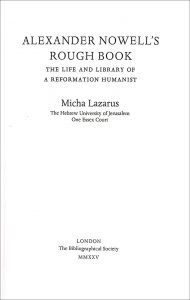
The rough book of Alexander Nowell (c.1514/15–1602) is a remarkable record of the life of a Reformation humanist as he navigated one of the most turbulent periods in English history. At Brasenose College, Oxford in the 1530s, Nowell documented the beginnings of the Oxford tutorial system. As headmaster of Westminster in the 1540s, he was among the first to teach Greek at grammar school, and directed the first performance of a classical tragedy anywhere in England. But no less striking are Nowell’s draft letters, memoranda, shopping lists for students, personal accounts, and list after list of books: 653 entries in all, amounting to a collection of 240 individual titles in a period in which the most senior scholar might have owned just seventy.
The scale of this collection alone marks Nowell as one of the great bibliophiles of his time and offers a major new source for the history of humanism, education, religion, and the book in Tudor England. Nowell’s ownership of evangelical books in particular – in a period when distribution of such books might be punishable by death – supplies long-missing evidence that 1530s Oxford, no less than Cambridge, was hot for reform. Yet the impact of Nowell’s collection reached far beyond his own shelves. At once market commodities, privileged intellectual objects, and means of payment, Nowell’s books circulated among a secondary readership of over 60 named individuals in Henrician Oxford and London, functioning as something like England’s first circulating library.
Alexander Nowell’s Rough Book: The Life and Library of a Reformation Humanist edits these materials from manuscript for the first time, and presents a new and intimate biography of a young humanist and his books at break of day in the English Reformation.
Author
Micha Lazarus is a barrister at One Essex Court in London and Senior Lecturer at the Hebrew University of Jerusalem, following research posts at Trinity College, Cambridge, and the Warburg Institute. He is the author of Leon Modena’s “Kinah shemor” (Skenè, 2023) and General Editor of Sources in Early Poetics (Brill), and his work in book history has been awarded the Gordon Duff Prize at both Oxford and Cambridge. He is a fellow of the Royal Historical Society and the Society of Antiquaries, as well as a member of the Bibliographical Society.
The Bibliographical Society, London.
xvi, 399 p.; ill.
ISBN 978 0 948170 26 3